Connected TV and Its Halo Effect on Paid Search and Social
Frankie Karrer | 6 Min Read
Connected TV (CTV) has become a high-impact marketing touchpoint for advertisers over the last several years. The sight and sound of the TV screen combined with the digital roots of paid search and social has made TV advertising a more powerful tool for businesses of all sizes, transforming the TV screen from a brand awareness play to a targeted performance marketing platform. It’s such a vital part of the modern marketers ad mix, because it creates a halo effect when run alongside paid search and paid social.
Halo Effect
When a strong impression in one area shapes judgment in another. Psychologist Edward Thorndike named it in a 1920 paper, and marketers use it for one channel lifting the results of another.
We wanted to dig a little deeper into the relationship between CTV ads and the impacts they can have on more traditional channels, like paid search and social, so we looked at our first-party data to get a better read on how adding CTV can affect the rest of a performance mix. All of these advertisers ran CTV on one platform, and the comparison is before-and-after, so the results show correlation.
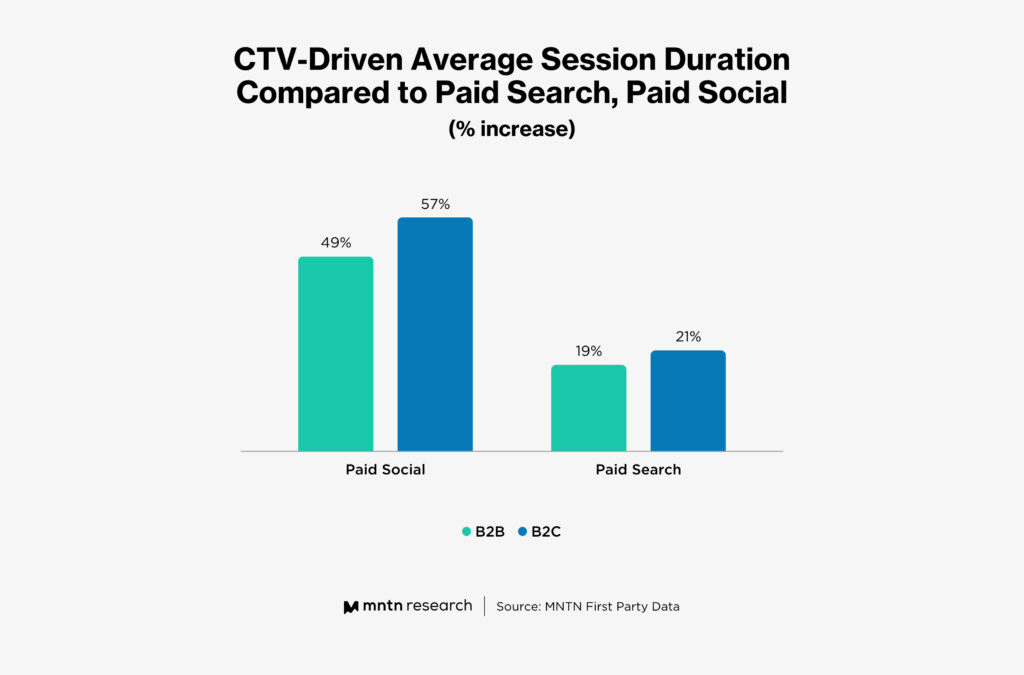
The data showed that Connected TV was generating longer site visits compared to the other channels in the ad mix. Across both business-to-business (B2B) and business-to-consumer (B2C) advertisers, the average session duration was higher for people who visited after seeing a CTV ad than for those who arrived from a paid search or social placement, which we see as a signal for more qualified site traffic.
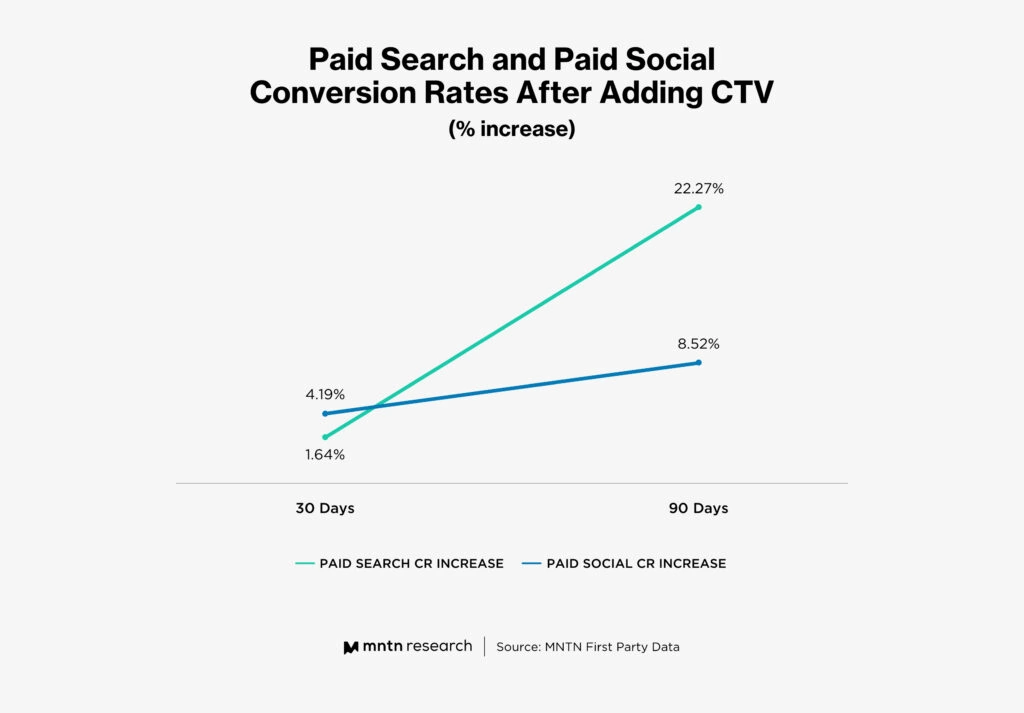
That doesn’t mean CTV negates the need for paid search and social altogether. Our data showed that, if anything, adding CTV made paid search and paid social work harder. Conversion rates for both channels had ticked up 30 days after advertisers added CTV to their mix and kept rising over the next 90 days.
These results are a textbook example of the halo effect. Connected TV performs on its own, and then helps lift the other channels in the ad mix.
How Connected TV creates demand
Why does Connected TV have this effect on the other channels? We think it comes down to demand generation. Paid search is great at capturing the demand of people who are already searching for the thing you sell. They’re easy to identify because they are already self-identifying. Yet that also can intensify competition since every other business can target the same group just as easily. And because you’re only capturing existing demand without creating anything new, that well of users will inevitably run dry.
Connected TV, on the other hand, can capture existing demand and create new demand, because it reaches people who would be interested in what you have to offer if they were aware of it in the first place. That awareness is what paid search and social can then capture. As the data shows, viewers primed by a CTV ad become more receptive to the search and social ads they see afterward.
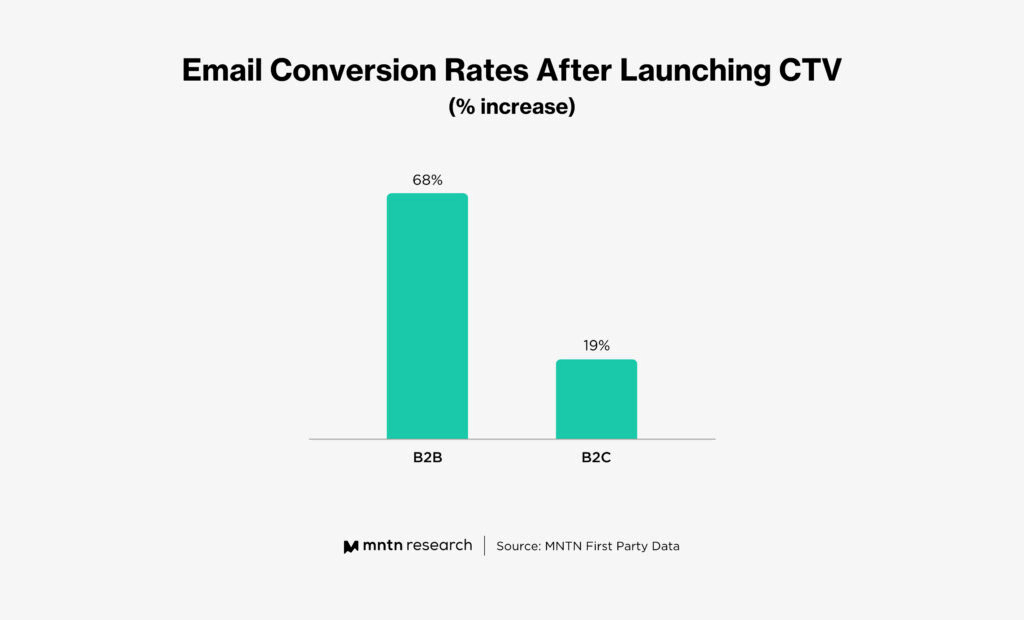
You don’t have to just trust our data. Academic research points in the same direction. A 2014 study in Management Science found that TV advertising for financial services brands increased related Google searches, and shifted searchers toward branded keywords instead of generic ones. Based on our analysis, we even see this impact email conversion rates across both B2B and B2C customers.
How CTV boosts the strengths of paid search and social
Looking more closely at the comparison between CTV and the other two paid channels, some interesting trends start to appear that likely speak to the strengths of each within the ad mix.
On average session duration, Connected TV showed a bigger increase in paid social than paid search. CTV visits ran 49% to 57% longer than paid social visits, and 19% to 21% longer than paid search visits. A user served with a paid search ad is already in the discovery mode and is likely looking to research or buy, so they’re going to spend some time on an advertiser’s website. This isn’t necessarily true for a user served a paid social ad. They may not be currently looking to learn more, but advertisers are hoping to shift them into that mode. Connected TV appears to do a better job at making this shift than paid social, which shows up as significantly more time on site. And while the paid search numbers are smaller, it’s notable that CTV visitors still spend more time on site than people who were already in discovery mode.
The conversion rate numbers highlight what can happen when Connected TV is combined with these strategies. The large lift in paid search (22% at 90 days) suggests CTV is priming the audience so they’re ready to convert once they start searching And while social doesn’t always reach users when they’re looking to convert, seeing a CTV ad first appears to make them more likely to do so, with paid social conversion rates up 9% at 90 days.
A note on campaign optimization
These results also reflect how the campaigns were optimized. The CTV campaigns in this data set were run against each advertiser’s performance goals, rather than for broad awareness, and they were auto-optimized during the flight to reach the audience most likely to hit the campaign’s key performance indicators (KPIs). Targeted that way, CTV can reach the people most likely to convert and lift other channels along the way.
Putting the halo effect to the test
Across this sample, adding performance-optimized Connected TV to a search-and-social mix coincided with longer site visits and rising conversion rates in both channels over 90 days, which is consistent with what academic research on TV and search has found for more than a decade. For a brand weighing the same move, that gives you a specific thing to look for and a specific window to look in: add CTV, then read your search and social conversion rates at 30, 60, and 90 days.
If you’re measuring CTV’s halo effect on your own performance goals, we encourage you to scrutinize your data along the way, just as we’ve scrutinized our own. If the campaign ran in a 90-day window, did it fall in a seasonal peak that could explain the across-the-board lifts? If you added a third channel, did you also raise your total spend, which could explain the uptick in performance? Connected TV may be just one contributor to the lift, or it could be the reason for the whole thing.