What Is Out-of-Home Advertising? OOH Media, Explained
Daniel Stock | 7 Min Read
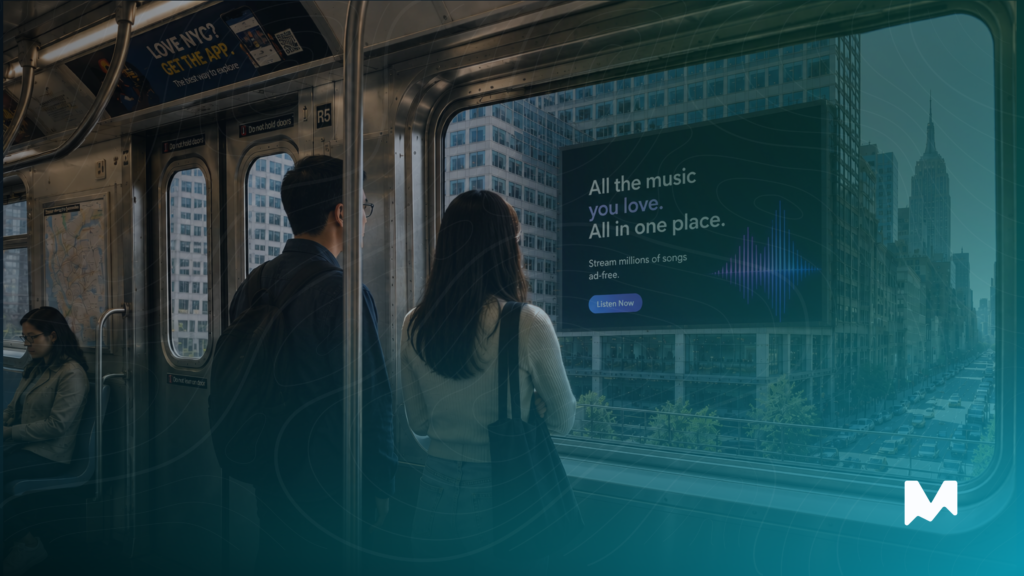
Marketers today face a crowded digital landscape where attention is fleeting, and ad avoidance is the norm. Out-of-home advertising (OOH) cuts through that noise by placing your message directly in the paths consumers travel every day. It’s a channel that feels both classic and cutting-edge, delivering the kind of real-world impact that performance teams increasingly demand.
In this article, we’ll discuss what OOH is, how it works, and best practices for incorporating it into your advertising mix.
What Is Out-of-Home Advertising?
Out-of-home advertising, commonly called OOH, is any paid advertising message delivered to consumers in public spaces outside their homes. It reaches audiences through formats like billboards, transit wraps, street furniture, and digital screens in high-traffic locations such as highways, airports, and shopping districts.
Unlike skippable digital ads, OOH is unmissable, capturing eyes during commutes, errands, and everyday routines for broad, contextual exposure that drives both awareness and action.
Brief History and Evolution of OOH Media
Out-of-home advertising dates back thousands of years, from ancient Egyptian obelisks used to publicize laws and treaties to painted public messages in Roman cities. The modern U.S. billboard era began in the 1830s, when Jared Bell printed large-format circus posters in New York, followed by the 1891 formation of the Associated Bill Posters’ Association of the U.S. and Canada, a predecessor to today’s OAAA.
For decades, OOH was defined by static billboards, posters, transit ads, and street-level placements. It provided reliable visibility in the real world before radio, TV advertising, and digital channels expanded the media mix. The next major shift came with digital technology, which added dynamic screens, faster creative updates, programmatic buying, and more data-driven planning to the channel’s long-standing physical presence.
That evolution is still gaining momentum. In 2025, U.S. OOH revenue reached a record $9.46 billion, up 3.6% year over year, while Digital Out-of-Home advertising (DOOH) accounted for 36.3% of total OOH revenue and grew 10.5%.
In other words, OOH hasn’t left its billboard roots behind. It has expanded into a more flexible, measurable channel that can work alongside paid search, social, and Connected TV.
Types of Out-of-Home Advertising
OOH media comes in five broad categories, each suited to different campaign goals and budgets.
1. Billboards & Large Format
Billboards are the classic OOH heavy hitters: big, bold placements built to reach people in high-traffic areas like highways, intersections, and city centers. This category can include traditional bulletins, digital billboards, wallscapes, and murals, all designed to make a brand hard to miss.
2. Street Furniture
Street furniture ads bring OOH to the pedestrian level, placing brand messages directly into sidewalks, transit stops, and other everyday city environments. Think bus shelters, kiosks, benches, newsstands, and other placements that meet consumers while they’re walking, waiting, commuting, or running errands.
3. Transit Advertising
Transit advertising reaches people as they move through public and private transportation systems. These placements can show up on buses, trains, rideshare vehicles, subway cars, transit stations, and airports, helping brands stay visible throughout the daily commute.
4. Place-Based Advertising
Place-based advertising puts messages in specific venues where audiences are likely to spend time, shop, work, or make decisions. Malls, gyms, office buildings, elevators, and entertainment venues all give advertisers a way to reach people in context, not just in motion.
5. Guerrilla & Experiential
Guerrilla and experiential advertising use unexpected, creative placements or real-world activations to get people’s attention. From wildposting and projection mapping to pop-ups and street teams, these formats are built to make audiences stop, notice, and ideally, remember.
How Does Out-of-Home Advertising Work?
Out-of-home advertising succeeds through a clear three-step process of smart buying, effective creative, and rigorous measurement that delivers the performance results marketers expect.
Buying OOH Media
Marketers buy OOH media either through direct deals with media owners for specific locations or via programmatic platforms that aggregate inventory across digital networks. This gives teams audience-based targeting, real-time flexibility, and efficient access to high-traffic placements, much like the buying workflows they already use for digital campaigns.
Creative Development and Placement
Creative development for OOH focuses on bold, simple designs with high-contrast visuals and concise messaging that capture attention in seconds. Strategic placement uses location intelligence and audience data to position OOH ads where target consumers naturally travel, creating the frequency and context that drive both awareness and action.
Measuring OOH Campaigns
Modern OOH measurement combines traffic data, mobile location insights, and advanced attribution models to connect exposure to real business outcomes like store visits and conversions. This data-driven approach lets marketers prove incrementality, optimize campaigns on the fly, and integrate OOH results seamlessly with their search, social, and Connected TV efforts.
Advantages of OOH Media
OOH delivers unique strengths that digital channels struggle to replicate.
- Unskippable Reach in Real Life: Consumers can’t fast-forward or block OOH. Your ad appears naturally during daily routines, delivering massive scale with high attention.
- Strong Brand Lift and Halo Effect: Research shows OOH boosts perceptions of premium quality and drives lift across other channels, much like Performance TV creates synergy with search and social.
- Measurable Performance at Scale: With DOOH and modern attribution, you get precise targeting, real-time optimization, and clear links to conversions, without the privacy headaches of cookie-based digital ads.
Challenges and Limitations
Like any channel, OOH has hurdles to navigate.
- Creative Constraints: Short dwell times mean messages must be instantly clear. Complex storytelling or small text simply won’t land.
- Higher Upfront Costs for Premium Inventory: Prime locations deliver results but require meaningful budgets, especially in competitive markets.
- Historically Limited Targeting: Traditional static formats lacked the precision digital natives expect, though DOOH and data tools have largely closed that gap.
Best Practices for a Successful OOH Campaign
Smart execution turns OOH from a visibility play into a high-ROI performance driver.
- Keep Creative Dead Simple: Bold visuals, big headlines, and one clear benefit win attention. Test variations to see what resonates fastest.
- Align Placement with Audience Behavior: Use location data to put your message where your ideal customers actually are, whether that’s highways for broad reach or malls for retail intent.
- Layer OOH with Digital Channels: Run it alongside search, social, and CTV for the halo effect that lifts overall performance and lowers acquisition costs.
- Leverage Programmatic DOOH for Agility: Schedule dynamic creative that responds to time, weather, or events so your campaign stays relevant without manual updates.
- Measure, Optimize, Repeat: Track impressions, visits, and conversions from day one. Use those insights to refine creative, shift budget to top-performing locations, and prove ROI to stakeholders.
Need More Visibility? Try Performance TV.
Out-of-home advertising can put brands in front of people as they move through the physical world, but marketers still need a way to connect awareness with measurable action. MNTN helps advertisers bring that performance mindset to premium streaming TV advertising, pairing high-impact reach with targeting, optimization, and reporting tools built around business outcomes.
Here’s how MNTN Performance TV helps marketers extend OOH-style awareness into measurable TV performance.
- Premium CTV Inventory — MNTN gives brands access to premium streaming inventory across top networks and apps, helping advertisers reach engaged audiences in high-quality, brand-safe TV environments.
- MNTN Matched — Advanced audience targeting helps marketers focus campaigns on households more likely to engage, convert, and drive stronger performance.
- Verified Visits™ — MNTN helps advertisers measure site visits and conversions tied to ad exposure, giving teams clearer insight into what happens after viewers see a TV ad.
- Automated Optimization — MNTN continuously adjusts campaign delivery based on performance signals, helping brands improve efficiency while media is still live.
- Reporting Suite — Real-time reporting helps marketers evaluate outcomes, monitor performance trends, and connect OTT advertising results to broader media goals.
Bring performance accountability to high-impact TV advertising—sign up today with MNTN’s self-serve software.
OOH Advertising: Final Thoughts
Out-of-home advertising has evolved from painted posters into a data-rich, performance-ready channel that fits perfectly in any modern marketer’s mix. It offers the reach, context, and unskippable presence that fragmented digital experiences can’t match—while delivering measurable results that matter to performance teams. As DOOH and programmatic tools continue to mature, OOH isn’t just surviving; it’s thriving as a strategic growth driver.
Want a Closer Look?
Discover how Performance TV delivers revenue, conversions and more through the power of Connected TV. Request a demo today to speak to an expert.