5 Stages of the Sales Funnel (With Examples & Strategies)
The MNTN Team | 9 Min Read
As a marketer, you’re always looking to build relationships with new customers and strengthen your sales with existing ones. But how do you make that happen?
To maximize your efforts, you’re going to need a deep and granular understanding of the stages of the sales funnel. Whether through CTV advertising campaigns that deliver premium reach or other performance channels, your ability to attract customers to the sales funnel and move them down its stages can make or break your sales and marketing operation.
There are five distinct sales funnel stages. Keep reading to learn (or refresh your memory) about each one, including some examples and strategies for how to master each stage, so you can drive customers toward your ultimate goal: an ongoing relationship with your brand.
What Is a Sales Funnel?
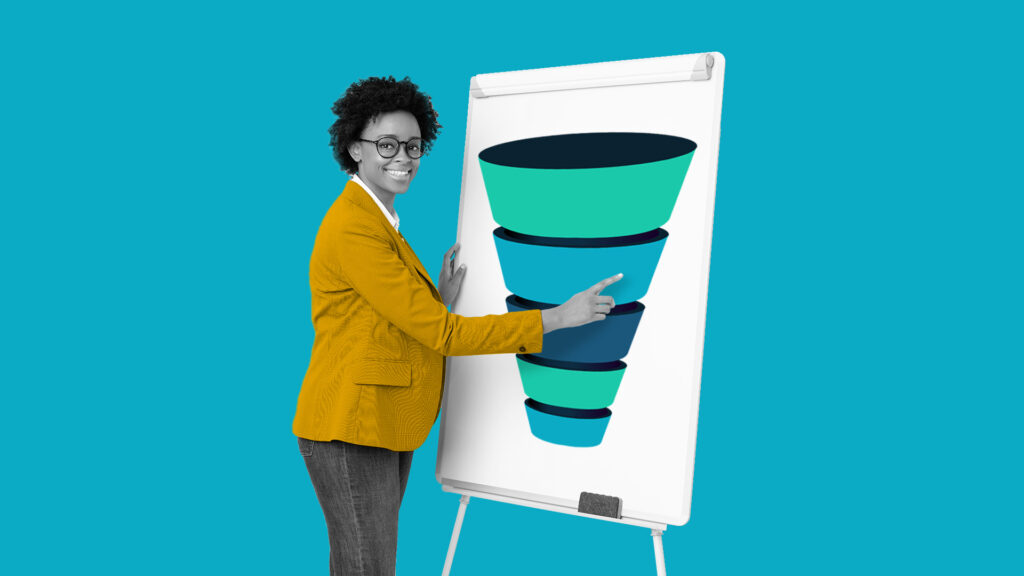
A sales funnel is a visual marketing framework that illustrates the customer journey from initial awareness of a brand or product to the final purchase and long-term loyalty. Shaped like a traditional funnel, wide at the top and narrow at the bottom, it helps marketers strategically guide prospects through each stage with targeted strategies to convert more leads into customers and drive sustainable growth.
- Learn more about the benefits of a sales funnel.
Sales Funnel vs. Marketing Funnel
Historically, companies have thought the difference between marketing and sales funnels is based on where a potential customer is in their journey. The two funnels were stacked on top of each other: the marketing funnel on top, the sales funnel right below.
The marketing funnel would appeal to a broad range of potential customers and build brand awareness. The goal would be to give these audiences a positive impression of your product or service, through things like ads, email newsletters, promotions, social media, and so on.
Once customers got to the bottom of the marketing funnel—i.e., they knew your brand/product/service and considered themselves potentially aligned with it—they would enter the sales funnel. At this stage, your marketing team would hand the customer off to your salespeople, who would then use a well-orchestrated pitch to guide them toward a sale based on where they were in their journey. The two teams rarely worked together.
Today’s marketers and salespeople favor a more holistic approach. Instead of operating in silos, the sales and marketing teams often collaborate, using stellar marketing to turn awareness into qualified leads. Research shows businesses with documented sales funnels generate 2.3x more ROI than those without.
With that said, it’s important to differentiate between marketing-qualified leads (MQLs) and sales-qualified leads (SQLs) before we discuss the funnel stages. Here’s a quick breakdown:
- Marketing-qualified leads (MQLs) are potential customers who have interacted with your brand in some capacity. They may have seen video ad campaigns, social media posts, offline ads, or any other marketing messages that resonated with them enough to convince them to learn more about your brand. While MQLs aren’t in your sales funnel yet, they represent real potential customers who fit your profile and deserve more attention. With the right messaging, your sales team can interact with MQLs to move them further down the sales funnel.
- Sales-qualified leads (SQLs) are MQLs that have officially entered the sales funnel. (Think squares v. rectangles: An SQL was once an MQL, but an MQL has not yet been an SQL.) An SQL knows their needs and has done more thorough research. They understand their budget and have a list of questions and concerns to address before they make a purchase.
Defining clear goals at different sales funnel stages will help you make good choices about your content and allow you to evaluate what is and isn’t working as you move prospects through the funnel.
Stage 1: Awareness
Who are you? (As a brand, that is.) What’s your raison d’etre? What’s your whole deal? The awareness stage (top-of-funnel) is where you let people know what you stand for. Everyone who has ever come across your brand is at this level, at least at first.
Any marketing channel can serve as a door to customer awareness. You can build familiarity with paid social media posts, static ads, YouTube, streaming TV ads, pay-per-click campaigns, and so on. A potential customer enters this stage before they even know what they’re looking for.
For example, a consumer at the awareness stage might stumble upon a mattress ad after a rough night’s sleep and check out your website for more information. Your goal in the awareness stage is to drum up interest in your product or service and to suggest your brand as the solution for a problem a potential customer has.
Success at the awareness stage lies in showcasing how you can address your customers’ needs. For example, the customer above may usually tune out furniture ads, thinking they don’t need new furniture. But after a few rough nights of tossing and turning, your ad starts appealing to their needs.
Strategies for the Awareness Stage
Marketers are seeing strong results when they focus on broad-reach tactics that introduce brands to new audiences in 2026. Here are five proven strategies:
- Run Connected TV campaigns to place your message in premium streaming environments where viewers are relaxed and receptive, building instant familiarity at scale.
- Create short, entertaining video content optimized for social feeds that highlights your brand’s personality without pushing a hard sell.
- Leverage influencer partnerships to expose your product to niche communities that align with your ideal customer profile.
- Deploy targeted display and PPC ads across high-traffic sites to spark curiosity and drive first-time website visits.
- Sponsor relevant podcasts or events to associate your brand with trusted voices and topics your audience already engages with.
Stage 2: Interest and Evaluation
Now that you have your hypothetical consumer’s attention, it’s time for the interest and evaluation stage, wherein they’ve started showing interest in your product. This is the beginning of what is referred to as the consideration stage (middle of funnel). They may not have committed to buying a new mattress, but they are taking measurable steps to learn more. This could mean filling out a query form or signing up for your mailing list.
Strategies for the Interest and Evaluation Stage
Data shows that providing value-first resources at this stage dramatically increases engagement and trust. Here are five proven strategies:
- Offer free educational webinars that dive into industry insights without naming your product, positioning your brand as the go-to authority.
- Send personalized email nurture sequences packed with “did you know” tips tailored to the prospect’s recent interactions.
- Create comparison guides that objectively break down category options, subtly showcasing why your solution fits real needs.
- Host live Q&A sessions on social or your site to answer common questions and demonstrate expertise in real time.
- Provide downloadable checklists or templates that help prospects evaluate solutions on their own terms, keeping your brand top of mind.
Stage 3: Desire
Your hypothetical mattress customer has decided they do indeed want to buy a new mattress. They have a budget and a sense of what’s out there. But they’re still actively weighing their options, and it’s not certain that your mattress will be their final choice.
Strategies for the Desire Stage
Research confirms that social proof and emotional connection are powerful at the desire stage, helping prospects visualize success with your brand. Here are five proven strategies:
- Feature authentic customer testimonials in video format to let real users tell your story and build emotional resonance.
- Share detailed case studies that map specific challenges to measurable outcomes your product delivered.
- Run interactive polls and quizzes on your site or social channels to engage prospects and gather insights while reinforcing your expertise.
- Highlight limited-time bundles that combine your core product with complementary items to increase perceived value.
- Create user-generated content campaigns that encourage satisfied customers to share their experiences, amplifying desire through peer validation.
Stage 4: Action
Your prospect has finally decided to pull the new-mattress-shaped trigger. You’re getting toward the bottom of the funnel, but you’re not there yet. At this stage, you may see your prospect put an item in their cart, then close their browser window. Yikes! So now you need to help your prospect push forward and buy something.
Strategies for the Action Stage
Marketers who reduce friction at checkout consistently see higher conversion rates in 2026. Here are five proven strategies to do just that:
- Implement one-click checkout options powered by saved customer data to eliminate last-second barriers.
- Send targeted cart abandonment emails with personalized incentives that address common objections head-on.
- Display real-time trust signals like security badges and recent purchase counters directly on the checkout page.
- Offer flexible payment plans or financing options that align with the prospect’s budget reality.
- Provide live chat support during peak shopping hours to answer final questions and guide the purchase in real time.
Stage 5: Loyalty and Re-Engagement
Finally, your customer hits that “purchase” button. At last! Now, they’re satisfied with their purchase. (We hope.) That means you’ve crossed the first and perhaps most significant barrier. But the full funnel isn’t over yet. Now, you want to keep them coming back for more.
Obviously, in our mattress example, that won’t mean buying another mattress (not for a few years, anyway). But there are still other ways of keeping that engagement: products related to their first purchase (a mattress cover? A mattress pad? sheets?), a subscription to a monthly package, ongoing support, or even spreading the word to others are all great options.
In fact, referred customers convert at 3-5x higher rates than other channels according to 2026 benchmarks, making loyalty programs one of the highest-ROI investments marketers can make. So don’t abandon your sales pipeline after your customers have made their first purchase.
Strategies for the Loyalty Stage
Top brands treat post-purchase engagement as the start of a long-term relationship rather than the end of a transaction. Here are five proven strategies:
- Launch tiered loyalty programs that reward repeat purchases and referrals with exclusive perks and early access.
- Send personalized post-purchase onboarding sequences that help customers maximize value from their new product.
- Create subscription replenishment models for complementary items that deliver convenience and steady revenue.
- Solicit and reward reviews with meaningful incentives while turning happy customers into brand advocates.
- Host exclusive customer communities or events that foster ongoing connection and generate organic referrals.
Learn How to Create a Sales Funnel
How CTV Advertising Can Keep Your Funnel Full
Your sales funnel is only as strong as the marketing that fuels it. MNTN Performance TV ensures your OTT advertising campaigns drive measurable results at every stage, from awareness to conversion. Here’s how our platform helps move prospects down the funnel:
- MNTN Matched: AI-powered audience targeting connects your brand with high-intent consumers at the top of the funnel.
- Creative-as-a-Subscription™: Scalable ad production keeps your messaging fresh and aligned with each funnel stage.
- Automated Optimization: Machine learning continuously refines your campaigns to maximize engagement and conversions.
- Verified Visits™ Attribution: See exactly how your OTT ads influence customer actions, from first touch to final sale.
- Real-Time Reporting: Granular insights help you adjust strategy on the fly, ensuring no opportunity is lost.
Turn awareness into action with MNTN’s self-serve software. Sign up today.
Sales Funnel Stages: Final Thoughts
Moving prospects through the stages of a sales funnel takes work, but it doesn’t have to be a chore if you develop a comprehensive strategy and utilize the right technology. CTV offers exciting new solutions, no matter where in the funnel your prospects are.
Want a Closer Look?
Discover how Performance TV delivers revenue, conversions and more through the power of Connected TV. Request a demo today to speak to an expert.