What We Learned From Running CTV Like Traditional TV
Eric Hatzenbuhler | 6 Min Read
One of the things I love most about our marketing team here at MNTN is that we’re always testing — pushing our platform and generally seeing just how far we can take Connected TV advertising. If there’s a question worth exploring (and okay, some of them probably aren’t), we’ll roll up our sleeves and find an answer. In our latest test, the question we asked ourselves was: What if we put a MNTN ad in front of everyone that watches Connected TV?
The idea for this experiment came up at a recent MNTN offsite, where Christopher Innes, Chief Operating Officer at MNTN, posed that exact question to a room of hundreds of MNTN team members. It got us thinking — could we run a broad-reach CTV campaign with minimal targeting parameters and still maintain cost efficiency? Or would going against our performance marketer instincts lead to inefficiencies that strain our budget and outweigh the potential benefits? We decided to find out.
Our Thought Process
Here’s the thinking: generally, broader audience targeting can lead to lower CPMs because it casts a wider net and opens up more inventory. But we also know that casting too wide a net can create inefficiencies that drive up costs. So, instead of going in with the assumption that broad reach would maintain cost efficiency, we framed this test around a different idea: what would happen if we ignore CTV’s targeting capabilities and apply a linear TV-inspired “Media Markets-only” approach? Would this reveal an overlooked opportunity, or would it confirm that sacrificing targeting precision leads to inefficiencies?
In most of our CTV campaigns, we take a performance-driven approach — using precise audience targeting to ensure that our ads reach the right people at the right time. And while that approach is what we usually recommend all marketers include in their strategies, it’s always good to double-check your suggestions to make sure they are backed up with evidence. So for this test we threw all that out the window and went with a campaign that had no granular targeting at all.
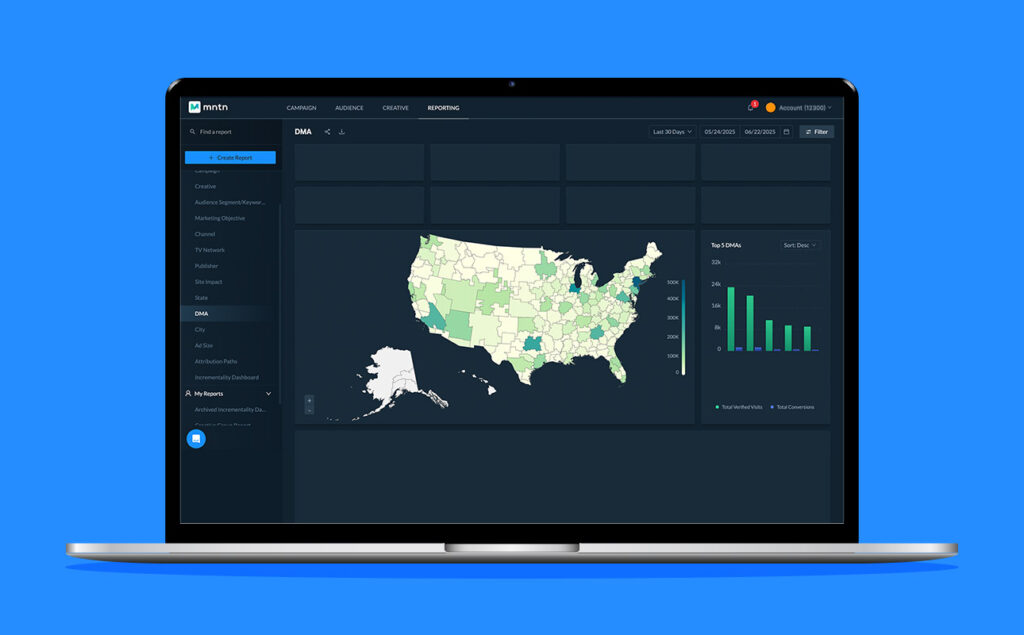
Instead, we structured the campaign more like a traditional TV buy, using Media Markets (Media Markets) to define our audience. If you’re not familiar, Media Markets essentially are geographic regions used by Nielsen to measure TV audiences. (Think zip codes, but on a broader scale.) For this campaign, we pulled a list of the top 50 Media Markets and input them into the MNTN platform, leaving everything else open.
Our hypothesis:
- While we expected inefficiencies, we predicted the sheer scale of broad reach would help keep CPMs in check, or at least offset the potential cost increases.
Running the Campaign
From a technical standpoint, this campaign was simple to set up — just a matter of inputting the Media Markets and selecting our campaign goal. Speaking of goals, we kept it consistent with our usual upper-funnel prospecting efforts, and optimized for cost per site visit (CPV). For creative, we also didn’t change anything, and used the same ads we typically serve to a prospecting audience. This helped to keep all of our variables as controlled as possible.
Here’s where things got interesting: the campaign didn’t perform quite like we expected. Instead of benefitting from the cost efficiencies that can sometimes come with broader targeting, the CPMs were higher than usual. In fact, the cost per site visit was 5x more expensive than our typical broad-reach campaigns.
In other words, running a CTV campaign like a traditional linear one proved to be significantly more expensive than our usual targeted campaigns.
What We Learned
There were three main things we learned from the initial test of this campaign strategy:
Takeaway #1: A Linear Approach to CTV Doesn’t Stack Up
This campaign mimicked a linear strategy, and the results show it was a less efficient approach than our typical performance-driven campaigns. The data reinforced what we ultimately already know: CTV is not linear TV, and trying to run it that way just doesn’t work. The best approach? Target the right audience with relevant interests and in-market behaviors — even at the top of the funnel.
Takeaway #2: CTV’s Measurement Gave Us Quick, Actionable Feedback
Even though this campaign was more expensive than we’d hoped, it gave us something traditional linear TV never could: fast, granular insights into performance. With CTV, we were able to quickly measure site visits and engagement, giving us a clear read on how this broad-reach approach impacted results. This real-time feedback loop helps us to course correct and quickly apply these learnings to future tests.
Takeaway #3: CTV’s Flexibility is Valuable for Both Performance and Awareness Campaigns
Ultimately, this experiment confirmed why CTV’s targeting and measurement capabilities are so valuable — especially when you’re tracking toward a specific goal. While broad awareness approaches, like linear TV buys, absolutely have a place in a media mix, CTV gives marketers the ability to refine their audience and optimize performance outcomes.
That means CTV campaigns can deliver more efficient results while still providing the scale that’s usually associated with traditional TV. So whether you’re running a performance-driven campaign or aiming for efficient upper-funnel awareness, CTV’s ability to track and measure outcomes gives you insights to fine-tune your strategy.
Final Thoughts
Connected TV’s biggest strength is that it merges the reach of traditional television with the measurability of digital. But, as this test revealed, not all strategies translate perfectly between the two worlds.
If you’re a marketer looking to scale your CTV efforts, our advice is simple: test, analyze, and adapt. The best campaigns aren’t just about reaching the most people — they’re about reaching the right people, and in the most efficient way possible. And that’s exactly what performance-driven Connected TV is built for.
Now that we’ve tested this approach, here are a few ideas on how we plan to refine our strategy to improve performance:
What’s Next:
- Layer in our typical interest-based targeting. This could help drive more efficient spending and better align the campaign with our core audience.
- Adjust the campaign goal. Instead of optimizing for cost per visit, we could shift to a completed view-based goal to focus purely on awareness.
- Test different creative variations. Maybe a different ad would perform better in a broad-reach environment.
As we apply these learnings to future tests, one thing is certain: every experiment brings us one step closer to unlocking even more potential from Connected TV.
Eric Hatzenbuhler is the Director of Performance Marketing at MNTN, where he oversees paid media, SEO, and email marketing efforts. Before joining MNTN, he worked at several advertising agencies managing paid media for clients ranging from SMBs to Fortune 500 companies across industries like B2B and CPG. As a proud, born-and-raised Minnesotan, Eric combines his drive to push boundaries and challenge the status quo with a passion for connecting with others and inspiring innovative solutions.