Aug. 202610 Min. Read
The AI Engine Behind the Bid: Inside MNTN’s Intelligent Intent Scoring

MNTN’s bidding system handles tens of millions of Connected TV auctions per minute. But speed is only half the story. The bidder also has to know which households are worth bidding on for your campaign. This is a decision it can’t make inside the 100-millisecond auction window. CTV has no click trail, so it has to arrive at each auction with its point of view already in hand.
Intelligent Intent Scoring is how it forms that point of view. Powered by MNTN’s machine learning engine, it decides, before the auction opens, which households are most likely to engage with your brand. The bidding system delivers the speed; Intelligent Intent Scoring is what makes the speed worth something.
Beyond category-based targeting
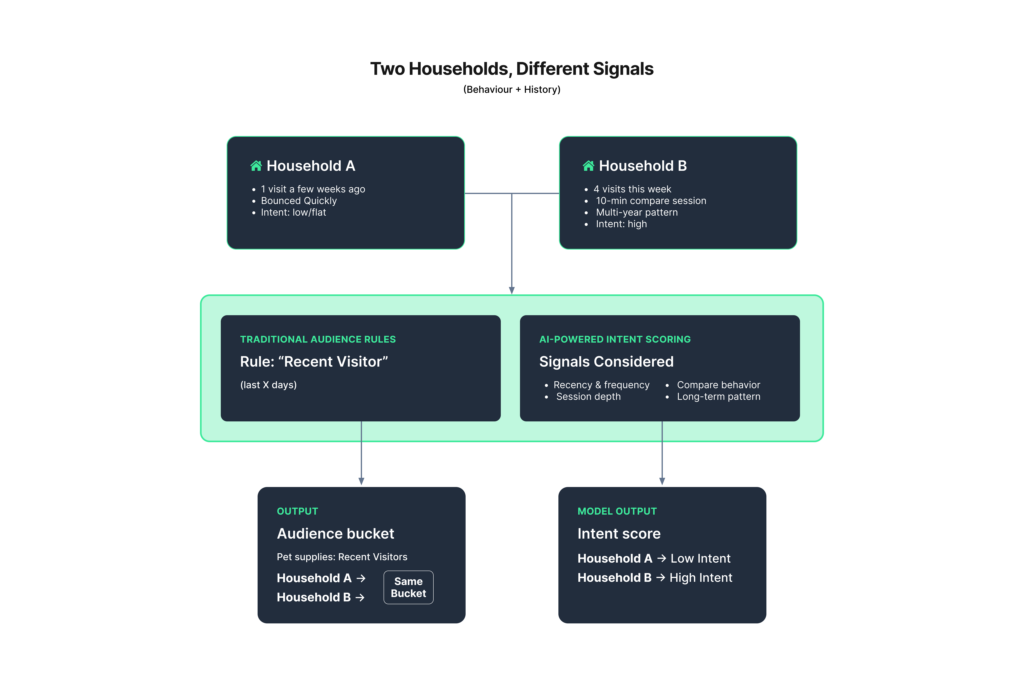
Intent targeting has traditionally relied on a coarser approach: categorize advertisers by their industry and the products or services they offer, then treat households browsing related products or services as in-market. It’s a clean rule, but a blunt instrument: it sorts households by the categories they touched, not by how much they want what you sell.
Ideally, intent targeting should score each household on its own merits (e.g. the full pattern of behavioral signals, their recency, whether that activity is rising or falling, and the breadth of engagement) relative to the kind of advertiser you actually are. That’s what Intelligent Intent Scoring does, and it’s how we unlock audiences that are both larger and more predictive than that coarser approach.
Consider two households the traditional categorization approach would treat as identical. Both visited a pet-supplies site once a few weeks ago. Lumped together as recent category visitors, they both land in your pet brand’s audience. But one bounced in eight seconds and has done nothing pet-related since. The other has browsed four pet-care sites in the last week, spent 10 minutes on a product comparison page yesterday, and has a multi-year pattern of pet-product engagement. Intelligent Intent Scoring sees those households as nothing alike, because for a pet supply brand, they aren’t. The second household is worth your dollar today, and our model knows it.
What the score represents
For the more than 120 million households in MNTN’s identity graph, and for every advertiser on the platform, Intelligent Intent Scoring produces a probability (a number between 0 and 1) that the household will visit that advertiser’s website in the next one to two weeks. That single probability is the engine’s output.
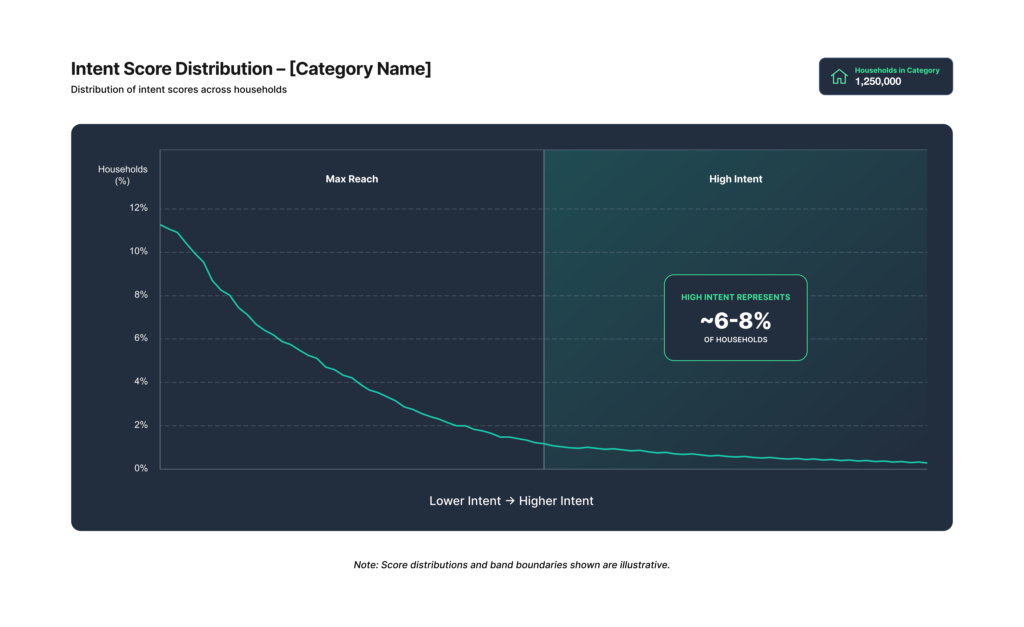
That raw 0-to-1 probability is mapped onto a customer-facing household intent scale, which is then split into the audiences you choose from when you build a campaign:
- High Intent. The households the model scores highest for your brand: the narrowest and most predictive group.
- Max Reach. The lower scores: lighter signal, but room to scale when needed to meet your campaign objective.
The score cutoffs that define those bands are tunable for each advertiser-category. So a High Intent audience for a small apparel advertiser and a High Intent audience for a national insurance brand carry the same promise (the top of that advertiser’s own range) even though the underlying score cutoffs differ. You get consistent quality targeting across advertisers of very different shapes.
Figure 2
MNTN refreshes these scores every day. When a household’s behavior changes (e.g. somebody who hadn’t been browsing pet sites suddenly visits three of them in a week), the score moves with it, and so does the audience they belong to. The bidder has the new picture before the next day’s auctions begin, with no action required on your side. A stale signal is one of the quieter ways CTV campaigns underperform; the refresh keeps your audiences current with your customers’ behavior today, not what they were doing last week.
How the model works
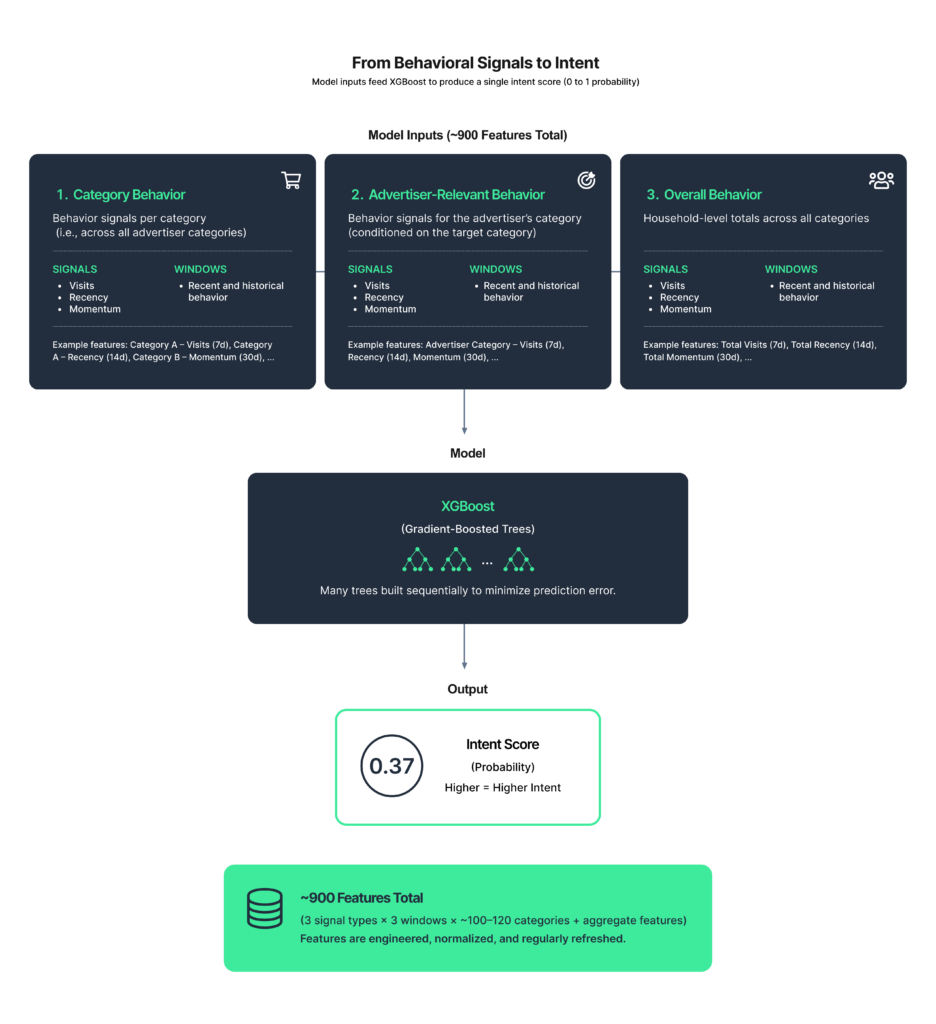
Under the hood, Intelligent Intent Scoring uses a gradient-boosted decision tree model: an ensemble of hundreds of models, each one trained to correct the mistakes of the one before it, adding up to a single prediction. The specific implementation is a proven, open-source implementation called XGBoost. We chose it for two properties in particular: it handles a very wide set of inputs, and its predictions are explainable. Handling large inputs matters because we feed it roughly 900 behavioral signals per household, far more than any human-created set of rules could weigh. The explainability matters because we can see which signals are driving its scoring decisions, which helps our team tune the model and investigate anything unusual in campaign behavior.
Those signals are household behaviors summarized over rolling 7-, 14-, and 30-day windows. Three groups matter most:
- Category signals. For every category MNTN tracks, the model sees site visit counts, recency, and momentum: has this household been browsing pet-product sites? Insurance sites? B2B software sites?
- Focused signals. The same visit, recency, and momentum signals, but conditioned on the category of the advertiser being scored: how this household behaves toward your kind of brand specifically, for example dog food, as opposed to more general category interest like pet supplies. These are the model’s heaviest-weighted inputs.
- Aggregate signals. Household-level totals: overall engagement and breadth. Does this household visit a lot of brands, a few, or none?
Figure 3
The model scores each household once per category. Advertisers in the same category start from that shared category score; a per-advertiser normalization then maps it onto each campaign’s own 1-to-10,000 scale, so the bidder ends up with a single number per household-and-campaign that it can read in microseconds when an auction opens.
Concretely: imagine the model scoring a household for a B2B software campaign. It sees three SaaS comparison sites visited in the last week (a recency signal), a steady 30-day pattern of business-software browsing rather than a one-off spike (a momentum signal), no engagement with consumer-retail categories (a discrimination signal that rules out coincidence), and a steady history of visits to advertisers in adjacent business categories (an aggregate signal). The model combines those into a single score for your campaign: not “this household is generally engaged,” but “this household is likely to engage with your brand.” Two households with identical total browsing can score very differently for different advertisers, even in the same category, and they should.
What the model learns from
The model trains against the same outcome MNTN tracks: did the household visit the advertiser’s website in the next one to two weeks after it was scored by the model? That visit signal comes from the same household event data that powers Verified Visits™ (MNTN’s attribution model for CTV), the same data that flows into your campaign dashboards. Training against the outcomes you see in your reporting keeps the model honest: it can’t get good at predicting something other than what you’re paying MNTN to drive.
The model is retrained regularly against tens of millions of rows of recent household behavior. Frequent retraining matters: CTV viewing patterns, household browsing, and the mix of advertisers on the platform shift week over week, and a model that has drifted out of date makes worse bids for your campaigns. Every retrain passes through the holdout testing described below before it has any chance of taking over production scoring.
From a probability to a bid: the daily flow
The daily pipeline that turns 30 days of household behavior into a bid decision runs on Google Cloud. Every day, in order:
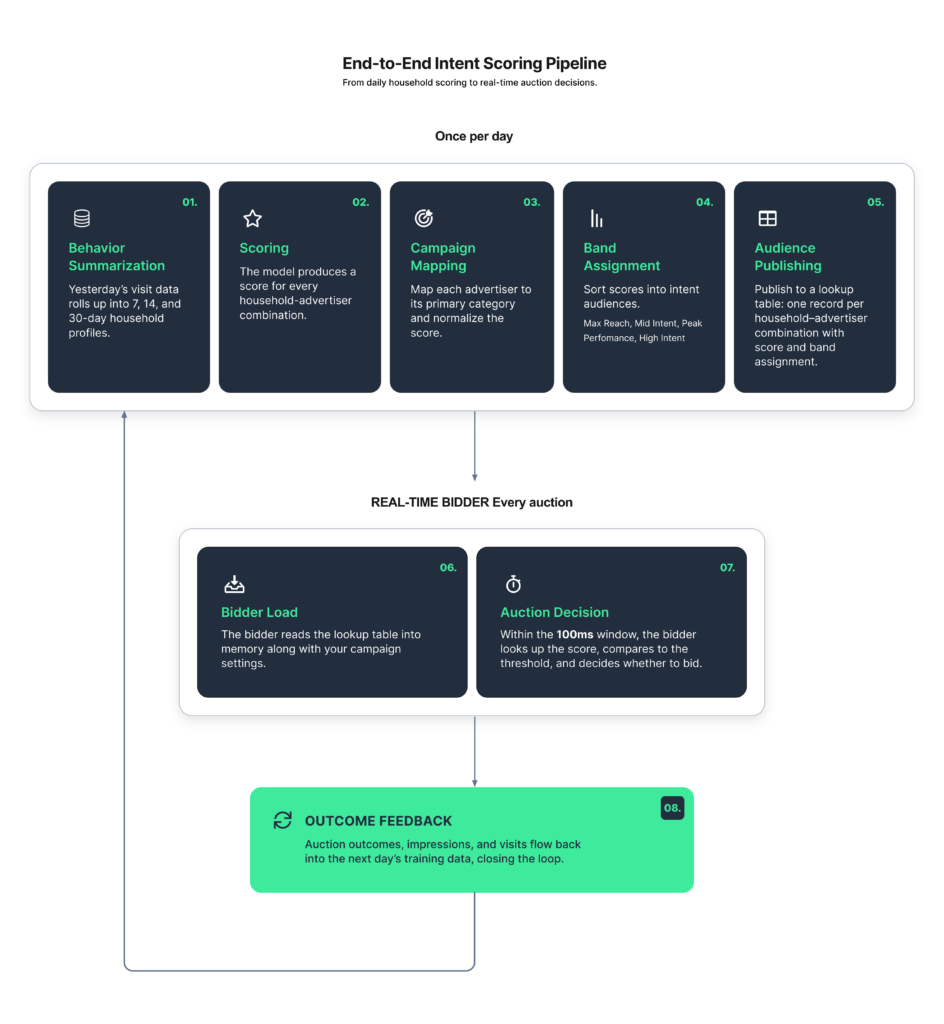
- Behavior summarization. Yesterday’s household visit data rolls up into per-household profiles spanning 7-, 14-, and 30-day windows.
- Scoring. The production model runs over those profiles, producing a raw intent score for every household-category combination.
- Mapping to your campaign. Each advertiser maps to its primary category, and a per-advertiser normalization turns that shared category score into a score on the campaign’s own 1-to-10,000 scale.
- Band assignment. Each campaign’s scores are sorted into its intent audiences (High Intent and Max Reach) using the per-category cutoffs described earlier.
- Audience publishing. The scored audience publishes to a lookup table the bidder can read: one record per household, listing every campaign the household qualifies for and the score that earned the qualification.
- Loading the audience. The bidder reads that lookup table into its working memory alongside the rest of your campaign settings.
- Auction. When the auction system fires a bid request, the bidder finds the household, looks up the campaign’s score, compares it against the campaign’s threshold, and decides whether to bid, all well within the 100-millisecond window.
- Outcome feedback. Auction outcomes, impressions, and visits flow back into the next day’s training data, closing the loop.
Scoring happens once a day in advance, not when the auction opens, because of the 100-millisecond constraint we covered in our bidding architecture post. There isn’t time in that window to score households in real time. Doing the heavy lifting in advance lets every auction use the model’s full-precision answer at no time cost.
How we keep it healthy
A model that targets your campaigns in real time is unforgiving of regressions. A bad analytics dashboard is just a bad dashboard, but a bad intent model distorts every bid for every campaign on the platform until somebody catches it.
A few practices protect against that:
- Holdout testing. Every candidate model is tested against recent household behavior that wasn’t part of its training. If predictions don’t hold up there, it never reaches production.
- Champion and challenger versions. The model currently scoring live traffic is the champion. Every newly trained model registers in our model registry (Google’s Vertex AI Model Registry) as a challenger: a candidate that produces scores in the background until it proves to be better than the current champion. A challenger only replaces the champion when it’s explicitly promoted, and promoting a new champion (or rolling back to the previous one) is a single registry operation rather than a complex redeploy.
- Training-to-scoring parity. Every model ships with a manifest of its exact feature layout, pinned at training time. Scoring validates against that manifest, so the inputs can’t silently drift out of alignment with how the model was trained.
- A/B tests. We validate every materially new scoring approach in a controlled live experiment against the production model before it takes over a meaningful share of bids. Intelligent Intent Scoring earned its place in the bidding system through exactly this kind of experiment, and we’d hold a successor to the same bar.
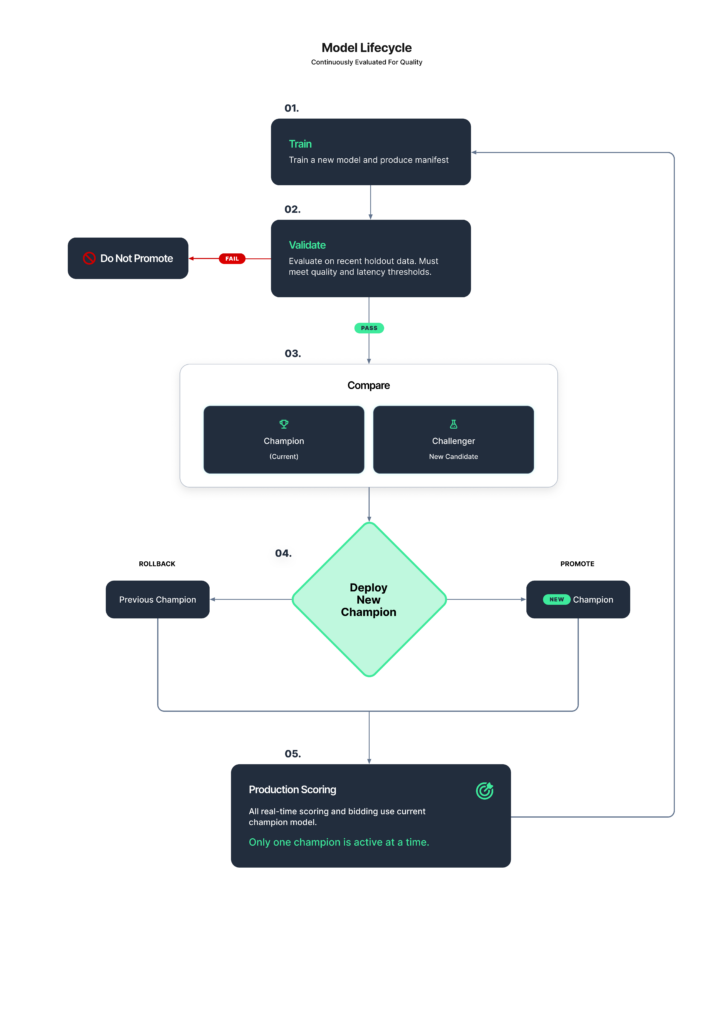
Intelligent Intent Scoring rarely shows up as a source of campaign volatility. New science is in development continuously; your campaigns only see it once it has cleared the bar.
Putting it all together
In a controlled rollout, Intelligent Intent Scoring drove an estimated 44% increase in return on ad spend and 37% lift in visit rate compared with advertisers not yet migrated to the new scoring system.
Connected TV gave marketers the reach of television and the measurability of digital, but it took away the click-by-click reactivity that makes search and social targeting feel intuitive. The bidder can’t follow your customer through a clickstream; it has to arrive at the auction already knowing who’s worth winning.
Intelligent Intent Scoring is how it knows.
For your campaigns, that translates into three things. Your audiences are built from a probability calibrated to your kind of advertiser, not a one-size-fits-all visit rule. Those probabilities are trained on the same outcomes you measure on. And the engine producing them is set up to keep improving without any change in how you run your campaigns. The bidder gets credit for the speed. Intelligent Intent Scoring is the reason the speed pays off.
Conclusion
Performance marketing on CTV looks effortless from the outside: an ad plays in the right home, a household visits the brand, the system reports a conversion. Behind that simplicity sits a tremendous amount of fast decision-making, and the most consequential decisions happen before the auction even opens. Intelligent Intent Scoring makes those decisions upstream, so everything downstream (the bid, the impression, the visit, the conversion) has the best chance of landing for your campaign. The unclickable screen is no longer a black box; behind it is a model that knows, every day, exactly which households are worth the bid.