Aug. 202629 Min. Read
The Technology That Puts Performance in Performance TV
How MNTN's Architecture Removes the Performance Taxes of Connected TV
Summary
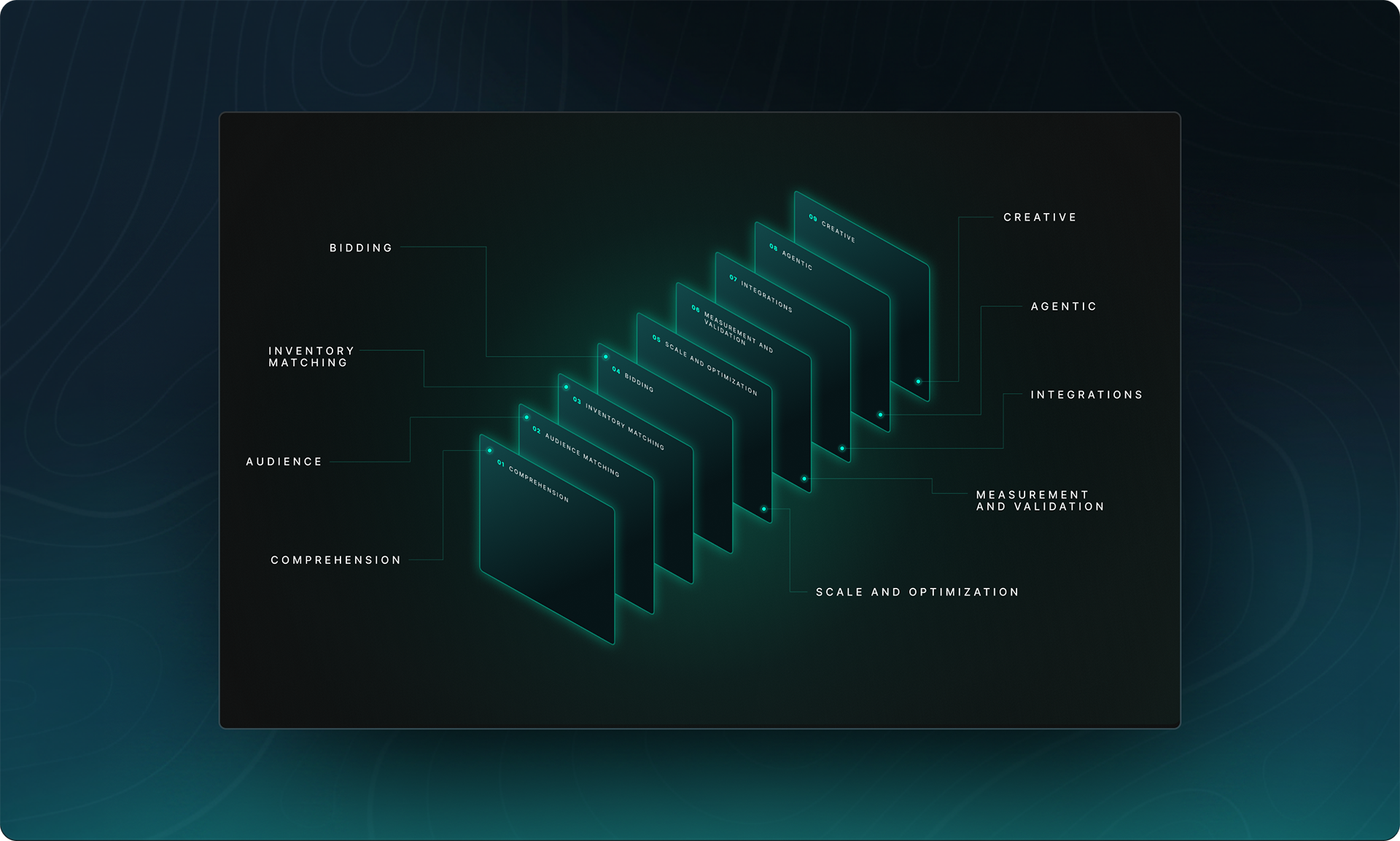
MNTN invented Performance TV™ years ago, and has led it ever since. Every layer of the system, from brand and audience comprehension through media planning, bidding, attribution, incrementality, geo, and frequency, is purpose-built technology against a single objective: acquiring new customers at the lowest cost and at the highest possible volume. The result is the most feature rich technology in the industry powered by the largest data set. This paper opens the hood on MNTN’s platform architecture and, at every layer, names the mechanism that produces the performance advantage.
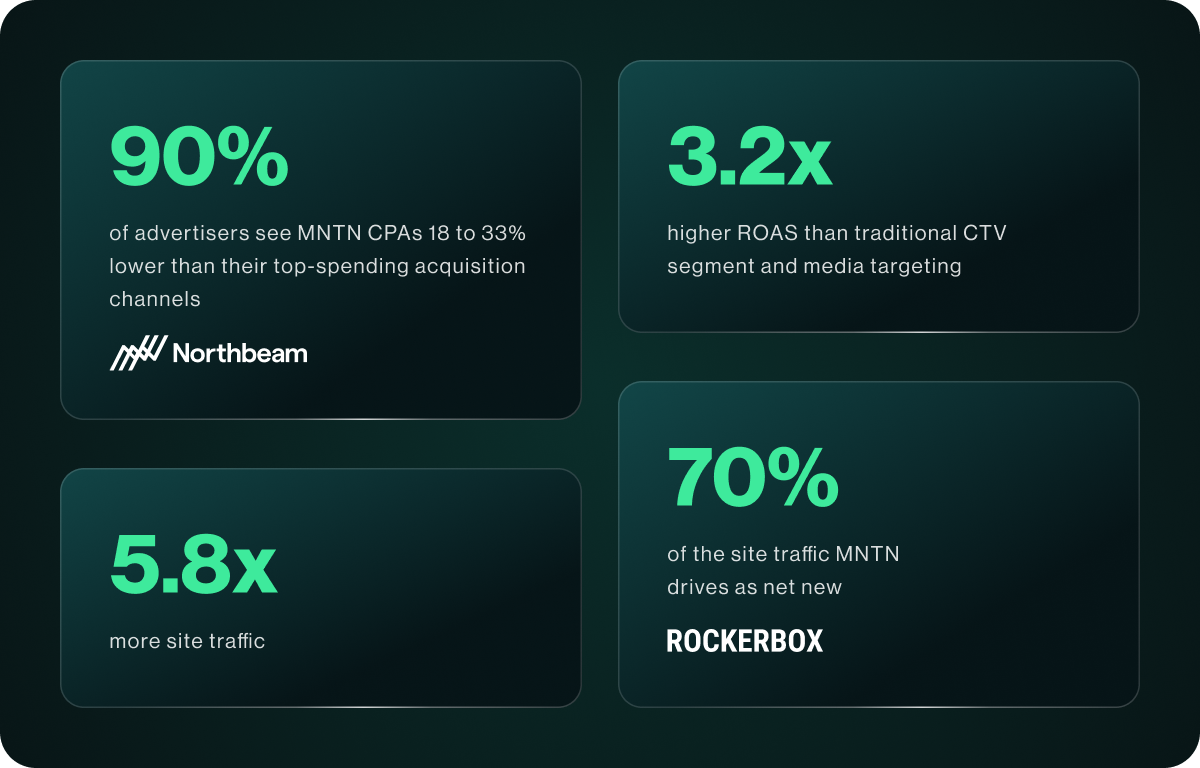
The results hold up under independent scrutiny. Rockerbox reports that 70% of advertisers see MNTN CPAs 18 to 33% lower than their top-spending acquisition channels, including paid social and other streaming TV. Northbeam measures 90% of the site traffic MNTN drives as net new. Across the platform, advertisers running MNTN’s matched audience and inventory systems average 5.8x more site traffic and 3.2x higher ROAS than traditional CTV segment and media targeting. And MNTN has 30 integrations (and counting) with third party providers to continue to validate our performance externally.
MNTN is so far ahead on the actual performance in Performance TV that we don’t compare our performance to other CTV solutions, we compare our performance to Google and Meta.
1.0
Introduction: The Performance Gap in Connected TV
Most connected TV platforms are, architecturally, display demand-side platforms that were retrofitted to traffic video, and three of their design decisions impose a performance tax before a campaign even launches.
- They buy pre-built audience segments assembled months earlier for as many advertisers as possible, so impressions land on households that were never going to buy.
- They bid into whatever supply their integrations happen to expose, leaving the highest-intent viewer unreachable at the moment of maximum receptivity.
- And while most now run some form of view-through attribution, few apply the deduplication discipline required to keep that signal honest, so the model learns from inflated credit and steers toward households it should have discounted.
MNTN’s platform answers each one directly. Instead of buying segments someone else built, it constructs the audience from a live model of the advertiser’s brand and buyers, refreshed continuously against real-time demand. Instead of bidding into whatever slice of supply an integration exposes, it sees every impression, decision, and bid in premium streaming television, so the highest-intent household is reachable at the moment it matters most. And instead of claiming credit generously, it deduplicates the signal that trains the optimizer, so the system learns only from the new visits television earned on its own.
Those three answers hold together because every component was built in-house rather than assembled from licensed parts. Performance in CTV is a systems property, not a feature. The audience model, the bidder, the identity graph, the attribution service, and the reporting layer all read from and write to one another in a single closed loop, and a platform stitched together from third-party components cannot close that loop, because the feedback never leaves the vendor it originated with. MNTN is the most complete platform in the category because it got here first and has kept pushing. What follows is a layer-by-layer account of that system, with the mechanism behind each outcome made explicit.
2.0
The Comprehension Layer: Understanding the Brand and the Buyer
Every impression MNTN serves is grounded in an understanding of two things: the advertiser’s brand, and the advertiser’s buyer. Both are built by MNTN’s AI, both refresh continuously, and neither works without the other. Together they are the foundation of the entire system and the largest structural difference between MNTN and every other Performance TV platform, which start instead at a broad media-buying layer focused solely on driving reach against an audience that someone else defined.
2.1Brand comprehension
MNTN’s AI performs a continuous deep analysis of the advertiser’s website: the products sold, the topics written about, the language used to position the offering, the logo, the color system, and every other signal of how the brand presents itself to the world. The crawl doesn’t just happen once at onboarding. Every change is captured, from a new product added to the catalogue to a repositioned category page to a headline where a lower-case t became a capital T.
What a brand sells and how it talks about itself is the highest single predictor available of who will buy next. A system that knows the advertiser sells technical trail-running apparel rather than generic footwear, and that knows what its actual buyers shop for, pinpoints a materially more convertible household on television. Comprehension precedes targeting, which is why MNTN’s targeting stays more effective than other forms of CTV targeting as volume climbs.
2.2Customer comprehension
The second half of the foundation is an equally detailed model of who actually buys, built in three enriching stages.
- First-party behavioral profile. MNTN’s visit and conversion pixels profile the users taking direct action on the advertiser’s site. Where a mobile measurement partner is integrated, install and in-app action data flow into the same profile, so app-side outcomes inform TV-side decisioning.
- CRM enrichment. That profile is enriched with customer segments the advertiser provides, by direct upload or through live integrations with systems including HubSpot, Klaviyo, Tealium, and mParticle. Synced segments refresh within 24 hours of any change, so the model never optimizes against a stale list.
- Matched™ modeling against real-time demand. MNTN’s proprietary Matched™ models take the combined first-party and CRM signal, enrich it with the brand data derived in §2.1, and match it against a massive database of real-time shopping and engagement behavior, powered by partnerships with retail media and eCommerce data providers and spanning over a trillion shopping, engagement, and behavioral signals analyzed every day. The output is a precise prediction of which households are most likely to buy this advertiser’s products next after watching their TV commercial.
The resulting composite profile refreshes continuously: on site behavior, on CRM sync, and on real-time shopping signals from prospective customers who have never visited the site. The audience an advertiser buys today therefore reflects demand as it exists today, not as a data vendor modeled it two quarters ago. It is also fundamentally different from lookalike modeling, which scores households on how closely they resemble customers already acquired. Matched™ scores them on live shopping and engagement behavior, so a household qualifies as an actual in-market buyer rather than as a broad resemblance to a past one.
Brand comprehension tells the system what to sell and how to say it. Buyer comprehension tells the system who is in the market for it right now. Performance comes from holding both at once.
3.0
Audience Matching Layer: Pinpointing the Households Most Likely to Convert
On conventional CTV, an advertiser buys broad syndicated segments built months earlier for the widest possible set of buyers, and therefore pays to reach people who were never going to buy the product. MNTN Matched™ was built to eliminate that performance tax.
3.1MNTN Matched™
Matched™ uses the brand and buyer comprehension described above to identify net-new households most likely to visit the site and convert after seeing the commercial. Site visitors and converters from the prior 30 days are excluded automatically, so budget goes to acquisition rather than to re-purchasing customers the brand already owns, and the exclusion window is configurable up to a year or more. Within that pool, budget is allocated first to the households MNTN labels High-Intent, those with the highest predicted likelihood of converting off the commercial, before extending to Max Reach households likely to convert later. That way, the earliest dollars in a flight are the most productive dollars. For national campaigns spanning a full product set, the Peak Performance setting extends delivery to 100% of the brand’s High-Intent audience across the country, maximizing volume at efficient cost instead of trading one against the other.
Crucially, the audience is legible and controllable. MNTN’s AI technology automatically builds the customer profile as keywords tied to shopping and engagement signals observed in real time. Because those keywords describe the consumer’s active behavior, they tell the advertiser who their customer actually is. This is the industry’s first keyword-based audience builder for television.
An apparel advertiser seeing “women’s luxury sports apparel” and “men’s luxury sports apparel” can remove either one to concentrate on a product-specific or creative-specific campaign. Keyword-level reporting then returns performance for each signal, so the audience is refined mid-flight around what is actually converting, and those learnings carry into search and social.
3.2Identity resolution: scaling the match across 99% of available US households
A precise audience profile is only worth as much as the share of the country it can actually be found in. MNTN resolves the Matched™ profile to real households at national scale using a proprietary, ID-agnostic identity graph that synthesizes:
- MNTN tracking pixels deployed on tens of thousands of websites, observing in-home cross-device connections first-hand.
- MNTN’s own device-to-household resolution across hundreds of millions of devices, including the connected TVs in each home.
- Billions of ads served per month, each contributing observed delivery and outcome signal back into the graph.
- A wide identifier set including Device IDs, IP addresses, Google IDs, and third-party identity partner IDs, so a household is resolved through whichever identifiers are actually present rather than through a single vendor key.
Those signals resolve into one household record that updates in real time. The same graph that finds the audience then connects the television impression to the visit or conversion that follows on a phone or laptop. It draws on the whole identifier set for cross-device identification, not one key, so the converting device does not have to still be on the household network. A viewer can see the commercial at home and convert on their phone somewhere else, and the match still holds. And because the number of devices tied to a household is capped, large shared networks like hotels and airports are never treated as homes. Coverage reaches more than 99% of CTV households in the United States.
The payoff runs in both directions. On the front end, an advertiser can effectively reach every high-intent household the Matched™ model identifies, so precision and performance do not come at the cost of scale. On the back end, ID-agnosticism is a durability property: as individual third-party identifiers deprecate, addressability and measurement accuracy do not degrade with them.
Matched™ audiences carry no data fees. Every dollar an advertiser commits goes to working media, which flows straight through to CPA.
4.0
Inventory Matching Layer: Premium Networks, Shows, and Live Sports Selected on Evidence
The same brand and buyer understanding that builds the audience also determines where the advertiser should air to drive the best performance. MNTN approaches this in two complementary ways, and the two together outperform either one alone.
4.1AI Media Plan
Most TV buying platforms ask for the budget commitment first and disclose where it went afterward. That sequence is itself a performance tax: when allocation is discovered rather than decided, the opening weeks of a flight are spent buying the information that should have preceded the buy, and the budget that funded that education is gone by the time it pays off.
MNTN produces the media plan up front. The AI cross-references the advertiser’s brand profile and high-intent household profile against the largest dataset of contextual and campaign performance data in Performance TV, an asset that exists because MNTN created the category and has been compounding outcome data across advertisers and networks ever since. It returns a ranked, budget-allocated recommendation of the premium networks where brands like this one actually convert.
After launch the plan does not sit still. The system continuously reallocates the network mix toward what is delivering an advertiser’s goal outcomes most effectively. A built-in Flex category also dynamically shifts budget to high-performing networks outside the original plan, so the campaign captures performance the plan did not anticipate. Every automated decision is exposed in a live newsfeed, so the advertiser always knows what changed and why. Manual mode is available at any time for teams that prefer to do some allocation themselves.
4.2Content-level targeting: shows and live sports
Below the network layer, MNTN uses the identity resolution described in §3.2 to determine which households are watching each specific show and live sports property available in MNTN Premium, then matches those households against the advertiser’s target audience. In parallel, brand comprehension identifies contextual matches: programming whose content elevates the brand. Pulling both levers at once produces a recommendation of specific show bundles and live sports to run alongside the network buy.
The lift is measurable. Content-level targeting combined with AI Media Planning drives a 129% lower incremental CPA than AI Media Planning alone. A recommendation derived from measured audience overlap plus brand-to-content fit is a different instrument entirely from a loose contextual list, and the difference shows up in the incrementality read. AI Media Planning, AI content recommendations, and Matched™ carry no fee, because each exists to put budget into performance rather than into platform overhead.
5.0
Inventory Layer: Access and Economics
Targeting precision is worth nothing without inventory worth winning. MNTN sources 98% of its ad inventory through direct relationships with streaming networks, with direct deals spanning 200+ networks including HBO Max, Paramount+, Peacock, ESPN, Hulu, Disney+, Bravo, and the NFL. This inventory is non-preemptible, guaranteed to air, and never remnant, and MNTN serves only non-skippable 15- and 30-second units.
Two performance mechanisms follow:
First, quality. MNTN research finds brand-safe video environments deliver a 233% higher conversion rate, fraud-free video 363% higher, and units of 15 seconds or longer 171% higher. Inventory quality is a conversion-rate variable, not a brand-safety checkbox. Read the other way, those figures describe a tax: every impression bought in an unverified, fraud-exposed, or skippable environment is bought at a conversion-rate discount that never appears on the invoice. Advertisers pay it in CPA instead.
Second, price. As one of the largest buyers of premium streaming television in the US, MNTN negotiates rates individual advertisers could not obtain and passes that buying power through as lower CPMs, buying more impressions against the same high-intent household for the same budget and resolving directly into lower CPA and higher ROAS.
MNTN Premium extends this access downward in commitment. Show-level CTV bundles have traditionally required upfront contracts, long lead times, and an obligation to absorb broad run-of-network inventory alongside the shows actually wanted. Premium is an eCommerce-style showroom for premium show-level bundles and live sports from the top streaming networks, available on demand, priced affordably, with no strings attached. Advertisers get culture-defining programming at rates most could not achieve independently, assuming they could obtain the access at all. Access alone is table stakes; pairing it with activation recommended on predicted performance, per §4.2, is what converts premium placement into measured efficiency.
6.0
Bidding Layer: Visibility and the Bidding System
6.1Complete auction visibility
MNTN operates at 100% queries-per-second reach. MNTN is the only platform that sees every ad impression, decision, and bid in premium streaming television for the emerging and midsize market segment. The consequence is concrete. A bidder that observes the entire stream can follow a target consumer across their whole viewing session and select the single best moment to reach them. Complete visibility turns a probabilistic reach problem into a deterministic selection problem. By contrast, a bidder that observes only a sample of the auction stream can target a household only when that household happens to appear in its slice. That limitation misses performance opportunities, artificially drives up the cost of reaching the customers that convert, and reduces the ability to drive effective outcomes at scale.
6.2A MNTN-proprietary bidder built for CTV, from the ground up
MNTN’s bidder is homegrown, not licensed: a microservice architecture running on Kubernetes, written in Kotlin, Python, and Rust, with the language chosen per service according to the latency and throughput profile of the work, and backed by Redis and Aerospike data stores. Audience score updates, spend events, and impression events are piped through Kafka to consumer services and loaded into those stores, forming a real-time feedback loop that gives the bidder the freshest possible state at decision time. Campaign metadata is pre-loaded into Redis caches by a dedicated cache-loader service, because reading it from the relational database at bid time is too slow to be viable inside the auction window.
An abstraction layer over supply-side platform integrations allows new SSPs to be added as supply evolves, and private-marketplace deal buying was a founding pillar of the architecture rather than a retrofit, which is what allows MNTN’s direct network relationships to be expressed as bidding advantage rather than merely as procurement.
Latency is the constraint that makes all of this necessary. An OpenRTB request gives a bidder fewer than 100 milliseconds to decide and respond, and a missed deadline is indistinguishable from a declined auction. Every choice above exists to ensure MNTN is present and correct inside that window, on every impression worth winning. MNTN evaluates as many as 4 million bid requests per second, from which it makes more than 300,000 bid decisions, on hosting infrastructure that is the largest in Performance TV and on par with enterprise-scale ad platforms.
6.3What the bidder decides
Bid decisions incorporate household affinity scores produced by MNTN’s AI engine, a per-household prediction of how relevant this campaign will be to this home, alongside live event data and budget state. Layered on top are dynamic daily pacing that reallocates budget by real-time performance, automated auction management modeling recency, frequency, and network, and continuous threshold adjustment as the AI collects feedback on its own bids. The price MNTN pays for an impression is set by how much that specific household is worth to this specific advertiser, which is the entire mechanism behind efficient CPA at scale.
Frequency capping deserves specific mention, because CTV makes it hard. A CTV ad may play several minutes after the auction is won, or never, if the viewer changes app or turns off the television, and naive systems overshoot their caps as a result. MNTN records a provisional impression immediately on auction win, counts it toward the cap, then reconciles it against the VAST playback event. If playback is confirmed, the provisional record’s time-to-live is cancelled. If no playback arrives inside the expected upper bound, the record is discarded. Cap enforcement is therefore accurate, which protects against the ad fatigue that silently degrades campaign efficiency over a flight. Recency rules and real-time spend pacing operate on the same live state.
7.0
Data Layer: Scale and the Optimization Loop
MNTN operates the largest campaign performance dataset in Performance TV, and the advantage compounds. Outcomes earned by similar advertisers on each network in prior quarters inform the media plan and bid thresholds of campaigns launching today.
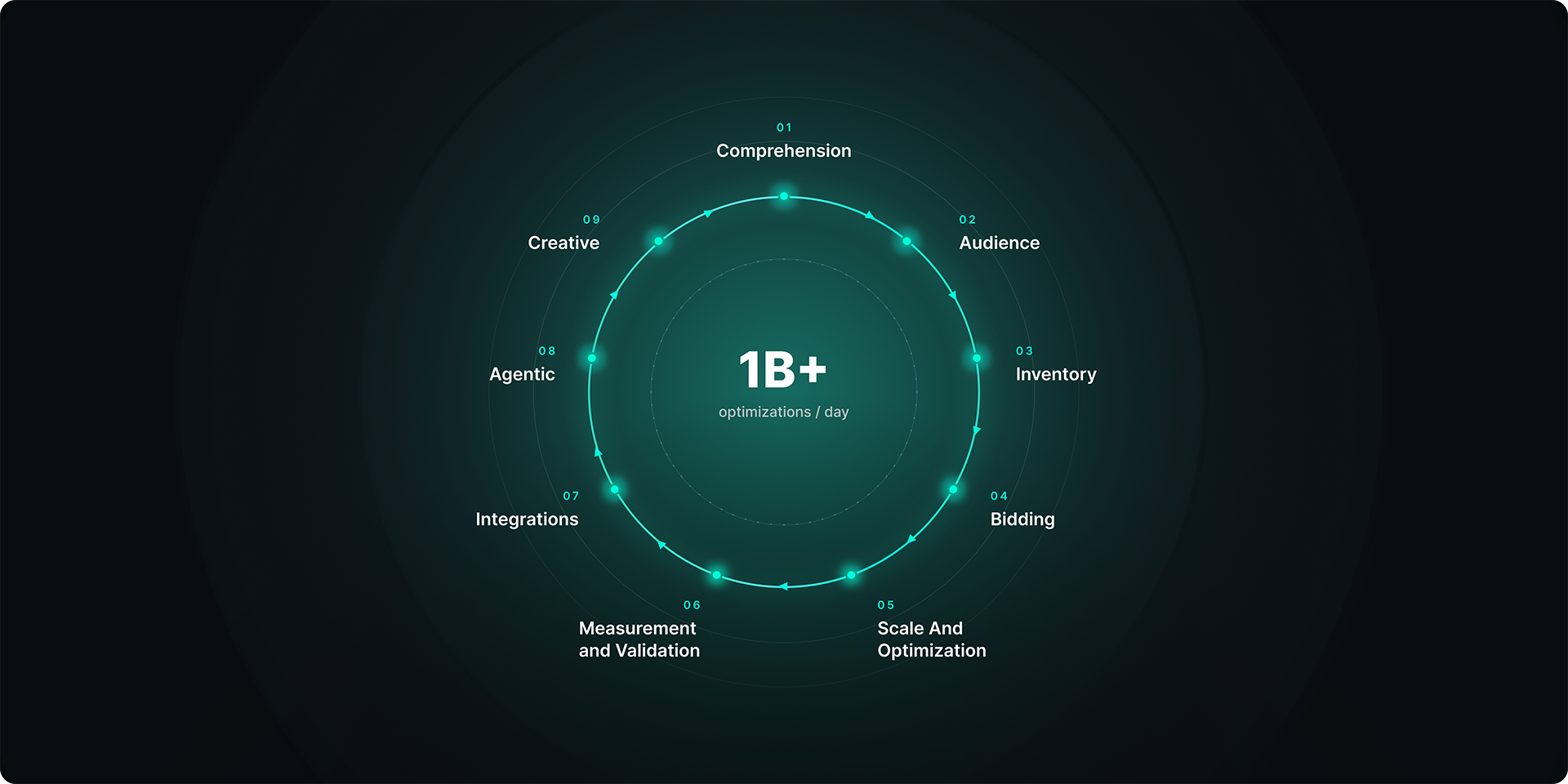
Scale on its own is inert. What converts it into performance is the closed loop. Signals inform affinity scores, affinity scores inform bids, bid outcomes inform thresholds, and thresholds inform the next signal window, more than a billion times a day, entirely within one system that owns every step. The engineering concentration is why the loop keeps tightening rather than plateauing.
8.0
Measurement and Validation Layer
A performance channel is only as credible as its measurement. MNTN’s measurement stack is deliberately conservative, because an optimizer trained on inflated credit optimizes toward the wrong households.
8.1Verified Visits™
Television cannot be clicked, so last-touch analytics rarely name it as a source even when it caused the visit. Verified Visits™ is MNTN’s patented replacement for the missing click. On impression, the VAST event carrying ad and identity information is written by the Verified Visit Service to a ScyllaDB store with a time-to-live matched to the advertiser’s attribution window. When a page view arrives via the Smarter Pixel, the service runs a three-stage decision: eligibility screening against advertiser allow- and block-lists, with traffic obfuscated by Apple Private Relay or VPNs disqualified; impression matching inside the configurable look-back window, resolving same-device and far more commonly cross-device matches through the identity graph described in §3.2; and a competing-source audit that parses the URL for UTM parameters and click identifiers and withholds credit where another paid channel delivered the final touch.
That last stage is deliberately self-penalizing. Roughly 25% of the time, a viewer sees a commercial, types the brand name without a domain suffix, lands on a search results page, and clicks a branded search ad. Television caused the visit, but MNTN does not push it into multi-touch platforms as a last-touch event rather than conflict with the explicit action the user took. Eligible visits post into GA4 as session-start events, keeping last-touch reporting there clean.
Deduplication governs what the optimizer learns from, not what the advertiser gets to see. MNTN’s own reporting shows every visit the campaign influenced, and any view can be filtered to first-touch or last-touch so performance can be evaluated whichever way the team defines success. Read together, the two bound the channel’s true contribution: first-touch captures the full halo, last-touch isolates the visits television carried on its own.
The optimizer runs on the last-touch set, and that choice is the performance lever. Because MNTN under-claims rather than over-claims when teaching the system, the conversion signal the bidder learns from is clean, and it steers toward households that came to the site off the commercial itself rather than households another channel was already going to convert. That is the mechanism behind finding genuinely new customers, and it is why third parties corroborate the result. Rockerbox, receiving Verified Visits directly and scoring them under whatever attribution model the advertiser prefers, finds 70% of MNTN advertisers seeing CPAs 18 to 33% below their top-spending acquisition channels.
8.2Ghost-bidding incrementality (beta)
Incrementality is only as credible as the experiment behind it, so MNTN rebuilt the experiment. Ghost bidding is the industry-standard holdout methodology used by Google and other major incrementality testers, and MNTN implements it inside the bidder itself rather than as a post-processing layer on top of delivery.
Holdout is enabled per campaign group. When a bid request arrives for a campaign group with holdout on, the bidder resolves the household against a holdout-state cache and lands on one of three answers. New households are assigned to the holdout or exposed cohort in real time based on their audience decile bucket, and the assignment is written back immediately. Households already in holdout are logged as a no-bid with a holdout reason code, and MNTN never bids on them for that campaign group. Households already out of holdout proceed through normal bidding. One decile serves as the holdout, giving a 10% holdout rate against nine exposed deciles, and assignment is scoped per campaign group, so a household can sit in the holdout for one campaign group and in the exposed cohort for another.
Three properties make this rigorous. It is an intent-to-treat design: holdout status is evaluated at bid time and suppression happens before the bid is placed, so the control group consists of households that genuinely would have been eligible for exposure, which preserves the validity of the causal comparison. The state cache supports read and write at full bid-request volume, so assignment is never stale. And the no-bid logs reconstruct the holdout cohort exactly for downstream reporting, so the comparison is auditable rather than modeled.
Analysis runs at two levels. Aggregate incrementality across all of an advertiser’s campaigns is the most statistically robust view and is the default presentation. Per-campaign incrementality is also shown, with a displayed confidence level, since splitting the analysis reduces sample size per segment. Reporting surfaces the holdout design, the holdout rate, and the statistical approach alongside the numbers, so an advertiser’s own data team can audit how the result was produced.
This is the difference between a lift number an advertiser can take into a budget meeting and one they cannot. Testing runs always-on inside the platform at no additional cost, and is corroborated externally through LiftLab, Haus, and WorkMagic. Northbeam’s independent read, that 90% of MNTN-driven site traffic is net new, is a closely related finding measured entirely from outside the system.
8.3A/B testing (beta)
Not every advertiser clears the volume a rigorous incrementality study requires, and even those who do need a faster instrument week to week. MNTN’s A/B testing runs controlled experiments across creative and audiences with clean splits and a clear winner, built on the same audience decile infrastructure that powers ghost bidding, which keeps the splits balanced and the configuration isolated between arms. Isolating a single variable means a performance move can be attributed to a cause rather than to a hunch, and testing the two largest levers in any CTV campaign turns one-off wins into a repeatable playbook that permanently raises the baseline the next flight starts from.
8.4Pivot reporting
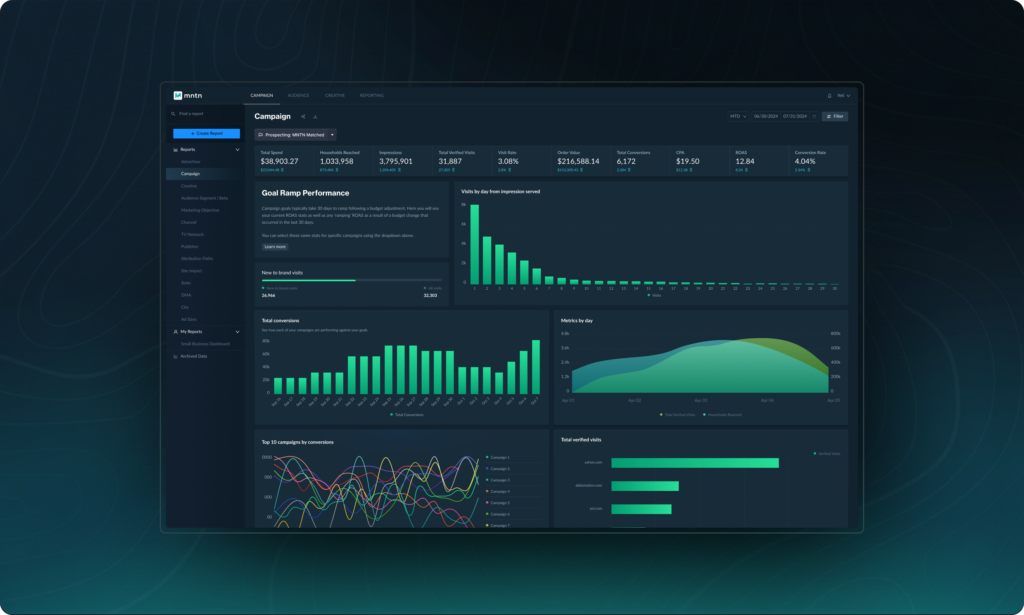
Pivot Reporting analyzes performance by campaign, creative, channel, publisher, ad size, TV network, marketing strategy, or audience, then pivots by a second dimension, creative within each campaign for instance, to isolate which combinations actually produce results. Timeline markers show when budgets changed and when audience data last refreshed, so a spike or a dip arrives with an explanation rather than a hypothesis, and any view saves as a custom report to share or export. Compressing the distance between a performance signal appearing and an operator understanding what caused it means the next decision is made on evidence, and campaigns improve flight over flight instead of drifting.
9.0
Integrations Layer: Third-Party Measurement Validation Where the Advertiser Already Works, and Activation Downstream
MNTN maintains more than 30 integration partners, in three functional groups, each with a distinct performance rationale.
- Independent validation. LiftLab, Haus, WorkMagic, Northbeam, Rockerbox, Prescient AI, Triple Whale, iSpot, Innovid, Upwave, and DoubleVerify verify MNTN’s performance under methodologies MNTN does not control, covering incrementality, MMM, MTA, de-duplicated cross-channel reach, brand lift, and delivery verification. MNTN’s performance holds up under that scrutiny, which is exactly what a channel needs when budgets are being defended in a planning cycle.
- Outcome capture. AppsFlyer returns in-app installs and purchases into MNTN reporting and the optimizer. CallRail passes calls and texts back as offline conversions. Quorum, Foursquare, Cuebiq, and Precisely measure store visits, with Quorum’s high-precision GPS attribution across 280 million opted-in US devices included at no cost. Freshpaint and Ours Privacy give healthcare brands HIPAA-compliant measurement with PHI blocked before it reaches MNTN. Each widens the set of real business outcomes the bidder can optimize toward.
- Audience and reporting infrastructure. Tealium, mParticle, HubSpot, Klaviyo, LiveRamp, and Bombora keep targeting and suppression current automatically. Looker, Funnel, TapClicks, CM360, Google Analytics, Google Tag Manager, and Shopify put MNTN data where the team already works.
Television as a trigger: email, SMS, and sales outreach
Two integrations turn the impression itself into a downstream marketing event. With Klaviyo, an advertiser targets their highest-value segments on television and then receives the ad view back in Klaviyo, where it can trigger the next email or SMS flow while the brand is still fresh in the viewer’s mind. With HubSpot, MNTN is the first CTV platform to bring TV attribution into a CRM: impression activity lands on the contact record itself, so a revenue team can see which leads saw the commercial and follow up by email or with a direct sales call. In both cases audiences sync daily in the other direction, so targeting never runs against a stale list. A television impression that also fires a timed email or a sales touch does more work than the same impression in isolation, at no additional media cost.
10.0
Agentic Layer: The MNTN MCP (beta)
MNTN exposes the platform through a read-write Model Context Protocol server, operable from Claude, ChatGPT, and other leading AI assistants. Marketers lose hours navigating dashboards to reach a straight answer about performance and campaign health. The MCP returns that answer in plain English in seconds, inside the tool the team already uses.
On the read side, the surface spans advertisers, campaigns, flights, audiences, creatives, geography, and the full reporting layer. An operator can rank campaigns by CPA over three weeks and ask which deserve more budget, find the one creative dragging an otherwise healthy campaign, detect fatigue by testing whether households reached has flattened while spend climbs, compare two audiences on last month’s results, surface markets with volume but poor CPA, or check pacing across every advertiser under management with a single prompt. On the write side, the same interface edits and acts: adjust budgets, pause or reweight creatives, modify audience and geographic targeting, and launch campaigns without returning to the UI.
Every optimization has a decision time and an execution time, and in practice execution time is where advantage leaks. The insight gets identified on Tuesday and implemented on Friday. Collapsing diagnosis and action into a single conversational turn means the optimization lands in the flight that generated the signal rather than the one after it. Read-write agentic control of this depth is unique in Performance TV.
11.0
Creative Layer: Removing the Last Barrier to Performance
Creative sits outside the optimization loop, but it gates entry to the channel and sets the ceiling on everything the loop can achieve. Historically it was the largest barrier to getting a brand on television at all. MNTN removed it.
11.1Free professional production for advertisers new to TV
For brands going to television for the first time, MNTN builds the first commercial for free, made by a vetted video professional. Advertisers with existing footage receive Best Practice Edits that make the asset TV-ready against MNTN’s performance guidelines in as little as one hour. Advertisers with nothing usable receive a QuickStart video built from their brand assets, QuickFrame AI, or premium stock footage. These are the commercials that actually go live, available once per account with no spend commitment required.
The quality gap is measured. 78% of creatives produced by MNTN-provided video professionals outperform videos made by the brand within the same campaign, and 89% beat the advertiser’s stated goal. For a brand that could not otherwise have gotten on television at all, this is the difference between having a performance channel and not having one.
11.2Quarterly creative programs for every advertiser
Beyond the first commercial, creative support is a unified, tier-based program. Advertisers committing quarterly spend earn packages whose benefits scale with investment: more packages, more add-ons, more of which may be custom, and more professionally supported videos as tiers rise. QuickFrame AI is included at every tier. Package types include Live Action, 2D Animation, Testimonial and Case Study, Product Spotlight, Commercial Remix, and Social Media Video, each customizable with standard add-ons such as additional edit rounds, :15 cutdowns, and motion graphics, or custom add-ons including long-form video, premium talent and location, and concepting.
Production budget is budget that is not buying impressions. Earning professional creative as a function of spend means no advertiser runs a suboptimal asset because production was the constraint, and it returns money that would have gone to a production line item back to the working media that actually drives performance.
11.3QuickFrame AI
MNTN owns and operates QuickFrame AI, named Best Generative AI Platform in Adweek’s 2026 Tech Stack Awards. QuickFrame AI produces broadcast-ready video without a production team. It builds a brand profile, generates video concepts, and creates finished commercials from a prompt, an image, product URL, and other starting points. It auto-reframes a social ad into a TV commercial, so an asset already proven on Meta or TikTok goes to work on the biggest screen in the home. It generates voiceover scripts and voiceovers, music and sound effects, holds products, characters, and locations consistent across scenes, and gives direct control over shot, lighting, and mood. Editing needs no editing experience: an AI editing assistant takes plain-language prompts and updates the commercial, alongside a timeline editor, scene replacement, and editing of existing video, while built-in CTV best-practice and compliance checks catch the issues that would otherwise cost a flight its first week. Finished assets publish directly into MNTN, TikTok, Meta, and Google. Advertisers can use QuickFrame AI for as low as $39 per month, multiplying their creative output at 99%+ lower cost than standard production. This opens up new A/B testing, more audience-specific messaging, and other creative opportunities that drive up brand performance. Plus, it offers brands money back from production to reinvest in performance-driving media.
Beyond access to QuickFrame AI, MNTN’s platform goes one step further. Using its unique understanding of the advertiser’s brand and audience, MNTN auto-generates ads with QuickFrame AI for the advertiser to start from, already aligned to the brand the system crawled and the buyer it modeled. Edit them, or create new ones from scratch. Creative testing cadence stops being gated by production lead time, and the first commercial an advertiser runs is informed by the same brand model that built the audience.
12.0
Conclusion
The technologies described here are a single loop, and the loop is the product. A model of the brand informs a model of the buyer, which is then enriched by the advertiser’s own first-party behavior and CRM data and matched against real-time demand. That composite profile is resolved to real homes across 99% of available US households and, jointly with contextual and campaign performance history, determines the inventory. Complete auction visibility and a purpose-built bidder convert that intent into impressions at the exact moment of receptivity, at rates secured through direct network relationships. Conservative, patented attribution and randomized ghost-bid holdouts measure what actually happened, and feed that truth back into the affinity scores that price the next bid. More than a billion optimizations a day tighten it.
Around that loop sits a creative capability that clears the way into it: AI generation grounded in the same brand model, free professional production for brands new to television, and earned quarterly programs that keep production costs out of the media budget and push more of every dollar into the working media that drives performance.
References
- MNTN. “Unleashing Performance: How MNTN’s Bidding System Delivers Superior Results.” MNTN Tech Blog, March 2026.
- MNTN. “Part Two: Inside MNTN’s Bidding Architecture.” MNTN Tech Blog, March 2026.
- MNTN. “How MNTN Measures Performance Without Clicks: A Deep Dive Into the Verified Visits Model.” MNTN Tech Blog, March 2026.
- MNTN Research. “Brand Safety Drives Stronger Performance Outcomes on TV.”
- Rockerbox, advertiser CPA analysis; Northbeam, net-new traffic analysis.
- Adweek. 2026 Tech Stack Awards, Best Generative AI Platform: QuickFrame AI.